

On the Making of Andy Warhol’s »After Munch« Series
Henriette Dedichen (H.D.) interviewing Donald M. Sheridan (D.S.), former assistant to Rupert Jasen Smith, Master Printer to Andy Warhol for the book WARHOL AFTER MUNCH devoted to Warhol’s 1980’s series of re-imaginings of the art of Edvard Munch, edited by Michael Juul Holm and Henriette Dedichen, published by the legendary Louisiana Museum of Art in Denmark to accompany an exhibition of the same name1
H.D.: In the period (1977–1985) you were assistant to Warhol’s Master Printer, Rupert Jasen Smith. Warhol received (1984) a request to create a portfolio after Edvard Munch’s lithographs “The Scream”, “Self-portrait with Skeleton’s Arm”, “Madonna” and “Eva Mudocci”. Were you in some way involved in or did you witness the making of the unpublished “After Munch” series?
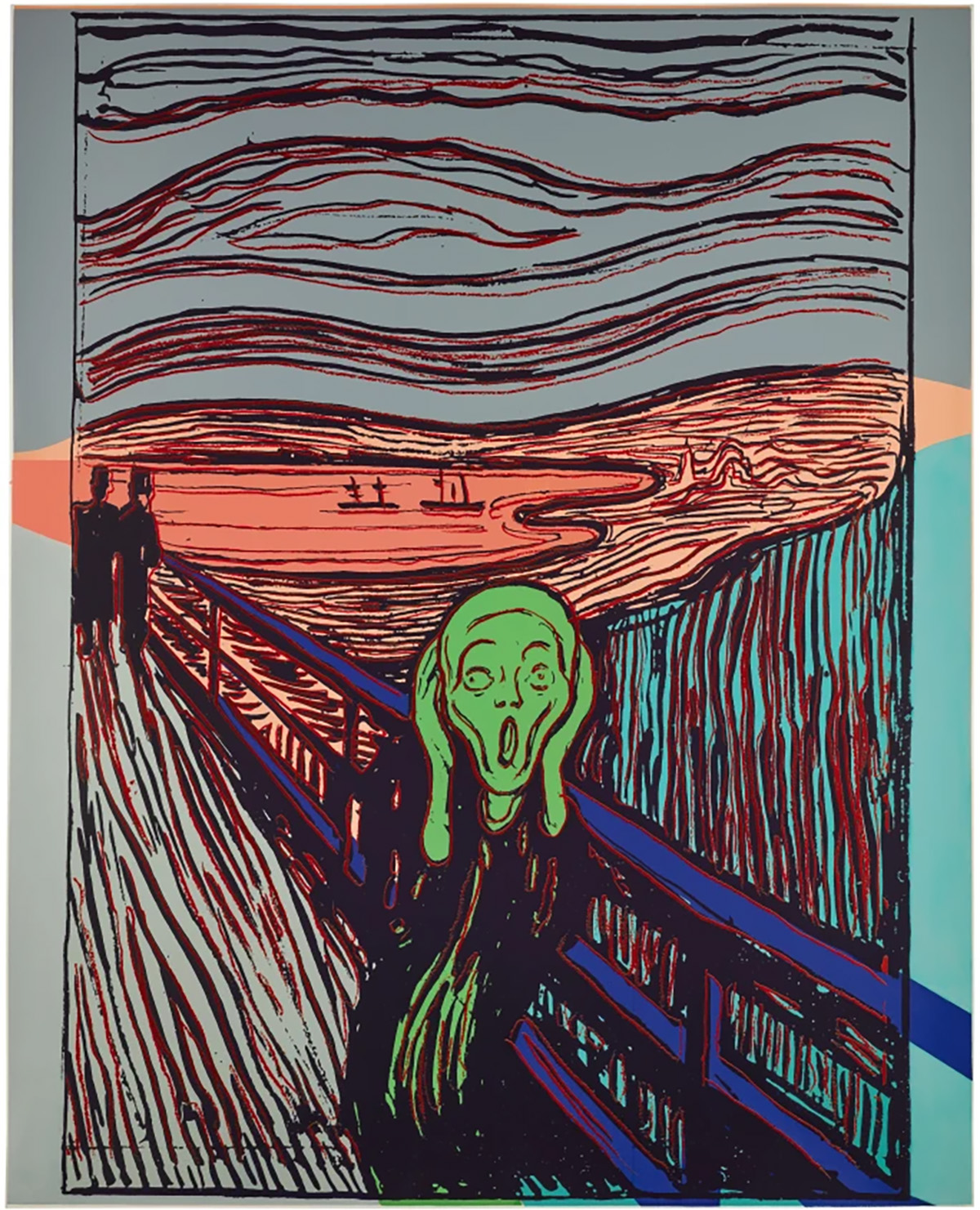
D.S.: Yes, I did work on some of these pieces.
Questions relating to the transfer from the transparencies to the acetate:
H.D.: From the contractor of the “After Munch” series, Warhol received photographs and transparencies as material basis for his silkscreens. How was the photo material of Munch’s images transferred to silkscreens?
D.S.: Warhol sent the photographic material of Munch’s lithographs to a photographic studio where the photographic images were enlarged and transferred into high contrast black and white images on transparent film called the film positive/acetate with the same size as the final image of the screen. Then the acetate was brought to a commercial printer to be transferred onto silkscreens in order to make stencils.
H.D.: In order to produce the “After Munch” screenprints, were one or more acetates made for each image?
D.S.: For the small sized screenprints in the exhibition; “Madonna and Self-portrait with Skeleton’s Arm”, “The Scream” and “Eva Mudocci”, two acetates were required for each, namely one for the photographic image (halftone) and one for the line Warhol drew directly on the acetate (either with crayon or graphite pencil). The acetate for the photographic image was made into a halftone positive in order to photographically reproduce the tonal images. This was achieved by placing the transparency in an enlarger where an exposure was made onto the acetate. The light passing through the transparency in the enlarger shone through a half tone screen that was placed in contact with the acetate resulting in a breaking-up of the tonal values of the transparency into a series of black and white dots of various sizes. The dots simulate the tonal values of the original image. This is apparent in the screenprints shown in the exhibition.
Questions relating to the stencils:
H.D.: How were the stencils made?
D.S.: In order to produce a stencil, a frame was covered with fine fabric (usually referred to as the screen-mesh) creating the silkscreen. The screen mesh was coated with a light-sensitive emulsion. Once the emulsion was dry, the acetate was placed onto the silkscreen and exposed to a bright light. Wherever light travelled through the acetate, the sensitized coating hardened, while the unexposed areas dissolved and became the open, printing areas. This fixed the image onto the screen and created a photographic stencil where an area was “open” for ink to be pushed through. The stencils would be taken back to the studio where they were used in proofing and printing Warhol’s work.
H.D.: How can you, by looking at a screenprint, identify whether one or more rubies have been employed? – According to Andy Warhol’s Munch Source Materials, The Archives of The Andy Warhol Museum, Pittsburgh, “The Scream” has 2 rubies, “Eva Mudocci” has 2 rubies and “Madonna and Self-portrait with Skeleton’s Arm” has 1 ruby.
D.S.: A ruby is a red transparent film that acts photographically like black, and will prevent light from exposing photo emulsion and hence block light. The ruby was placed on top of the Lenox Museum Board with the acetate facing down, and was then cut as desired to the shape of the image, after which the layers were either peeled off wherever light was desired to go through or left wherever light was desired to be blocked. After these steps, the photo-emulsion-coated silkscreen was exposed with light. Rubies allowed the printer to become more creative with colour.
Questions relating to colour and colour composition:
H.D.: Before the printing started, the colour-composition in the print had to be decided. Who decided the colour composition?
D.S.: Warhol’s Master Printer, Rupert Jasen Smith, made the decisions in agreement with Warhol. Once the composition of colours was finalized, a guideline for the printing of the layers of colours was made.
H.D.: All the small sized “After Munch” screenprints shown in the exhibition are multicoloured and some have as many as 12 colours. How many stencils and/or rubies were required to make one “After Munch” screenprint with 12 colours?
D.S.: When printing, ink is put onto the silkscreen and dragged with a squeegee across the silkscreen, pushing ink through the open areas in the mesh of the screen. Each colour in an image represents a different silkscreened layer. A screenprint with 12 colours required the use of 12 different stencils.
H.D.: What was the time required to make a 12-coloured screen print?
D.S.: Considering that oil ink was used, the printing of a 12-coloured screenprint could take 3 weeks. One has to consider that each colour had to dry before one could start the printing of the next layer of colour.
H.D.: What type of ink and what colours were used for the “After Munch” series?
D.S.: The ink used to print these screenprints had to have certain characteristics in order to be suitable for screenprinting. As mentioned, oil ink was used, but it had to be non-oily, short and buttery in consistency, and have sufficient body for sharp, even printing. All screen inks consist of a vehicle (also called binder) and pigment. The vehicle generally determines the drying time of the ink. This type of ink was available in matte and gloss finishes. It was heavy, intense, and for the most part opaque, although it was easy to control the inks’ thickness and light-reflecting qualities. The ink used for the “After Munch” series was called “Union”, but this specific type of ink is no longer produced. The fundamental colours were 8 comprising yellow, cyan, magenta, red, blue, green, white and black plus enamels, meaning gold and silver. These fundamental colours were used both clean and mixed in the making of the “After Munch” series.
H.D.: Who mixed the colours?
D.S.: Mr. Smith and his assistants mixed the colours.
H.D.: When printing the multicoloured “After Munch” screenprints, which colours were printed first?
D.S.: The colours that represented the largest areas had to be printed first. By doing so, the printer got a feeling early on of the overall tonality of the print since the printer had to anticipate the way in which the colours would blend when they overlapped. Endless colour combinations within each composition were possible.
H.D.: What colour effects were achieved in the “After Munch” screenprints when dragging the squeegee across the silkscreen, pushing ink through the open areas in the mesh of the screen?
D.S.: A number of color effects were achieved, for example an even color or a "rainbow". In the latter case, a rainbow roll was applied. With this method it was possible to achieve tonal effects with two or three colors on one screen. One method was to place two or three different colors of ink across the top of the screen and to squeegee them across the screen.
The printing itself created a gradual blending of colors. Among the "After Munch" screen-prints shown in the exhibition, this is apparent in the line in the hair of "Eva Mudocci" as well as in the line in the "Madonna and Self-portrait with Skeleton's Arm".
H.D.: To what degree was registration important when printing the "After Munch" screen prints?
D.S.: Registration is always crucial when making a multicolor print, but perfect registration with silkscreen stencils is practically impossible, thus, there will always be some overlapping. Warhol exploited this to his advantage, making a virtue of overprinting.
Of the "After Munch" screen-prints shown in the exhibition, this is particularly apparent in one "Eva Mudocci" and one "Madonna and Self-portrait with Skeleton's Arm". Warhol liked slightly out-of-register images.
1 Mr. Sheridan is the owner of a silkscreen studio, is a silkscreen printmaker, and is Adjunct Faculty at The School of Visual Arts in NYC teaching printmaking/silkscreen.
Resumé
Biographical essay